Most growth problems aren't marketing problems.
They're positioning problems.


Your rebrand will fail if you do not understand the brand Vs positioning difference.
Not because the design is bad or because the agency didn’t deliver. Not because the messaging isn’t compelling.
It’ll fail because you’re branding a commodity position.
Companies rebrand constantly. New logos, websites, messaging. Six months later, nothing’s changed. Same win rates, price competition and you’re more expensive than [competitor]’ conversations.
The problem isn’t the brand work. The problem is confusing brand strategy with positioning strategy.
Most companies don’t understand the difference between brand and positioning. They use the terms interchangeably. They follow conventional advice: be unique, be relevant, be credible. That works for brand messaging. But it doesn’t address strategic positioning, where you compete, not just how you differentiate. They hire ‘brand strategists’ to solve positioning problems. They invest in brand positioning work without establishing strategic position first.
Here’s the distinction:
Positioning = Where you compete (strategic territory)
Brand = How you present that position (visual + verbal identity)
Brand strategy articulates your position. It doesn’t create it.
If you haven’t decided where you compete, if you’re positioned identically to competitors, then brand work makes that commodity position look prettier.
You’ve invested in brand positioning for a position that isn’t differentiated.
Brand agencies deliver beautiful work. That’s not the issue.
The issue is this: They’re designing brand strategies for commodity positions.
A SaaS company rebrands. Changes ‘collaborative project management software’ to ‘collaborative project management platform.’ New visual identity. Same position. Still competing with Asana, Monday, ClickUp, and a dozen others saying identical things.
Professional services firms do the same thing. Manufacturing companies. B2B services.
Beautiful brands. Commodity positioning. Nothing changes.
The pattern is consistent across industries.
This is the brand vs positioning problem nobody’s talking about. Companies invest in brand when they need positioning.
Agencies know this will happen. They know brand strategy without positioning strategy fails.
Why don’t they tell you?
Because it kills projects.
Client says: ‘We need to differentiate from competitors.’
Agency can respond two ways:
Path 1: ‘Before we design anything, you need to establish strategic position. Where do you compete? What territory do you own that competitors don’t? This might reveal you don’t need a rebrand, you need repositioning.’
This conversation ends projects. Or makes them smaller, cheaper, less profitable.
Path 2: ‘Let’s create a distinctive brand identity. Here’s our process: discovery, brand strategy, design, messaging, guidelines, website.’
Project signed. Fee secured. Everyone moves forward.
Agencies are economically incentivised to skip the positioning problem.
They deliver what clients ask for. Clients ask for brand. Agencies provide brand. The positioning vacuum underneath never gets addressed.
This isn’t malicious. It’s market dynamics. But it’s expensive for you.
Open five competitor websites in your category.
B2B Software:
‘Leading platform for [X] teams’
‘Powerful solution for [Y] outcomes’
‘Trusted by enterprise companies’
Professional Services:
‘Strategic partner delivering exceptional results’
‘Expert consultants with deep industry knowledge’
‘Trusted advisor to [sector] leaders’
Manufacturing:
‘Quality [products] with reliable delivery’
‘Precision engineering, proven track record’
‘ISO certified excellence’
B2C food:
‘We deliver within 24 hours’
‘Freshness guaranteed’
‘Trusted by families for generations’
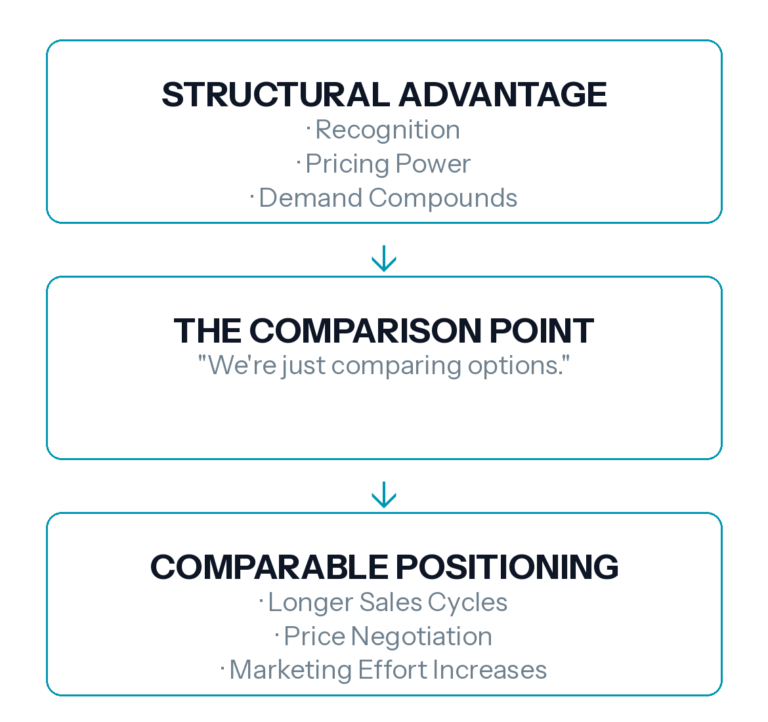
Everyone says functionally the same thing. Everyone competes on features or credentials. When positioning is identical, price becomes the deciding factor.
This is RED LINE positioning – a contested and commoditised space where multiple competitors claim the same territory.
When you rebrand a RED LINE position, you’re decorating commoditisation. Your brand positioning work is built on a commodity foundation.
I’ve spent 15 years in marketing and sales. The pattern is clear:
Companies mistake brand for positioning.
They think brand creates differentiation. It doesn’t. Position creates differentiation. Brand articulates it.
This brand vs positioning confusion is expensive. Companies invest heavily in brand strategy – visual identity, messaging frameworks and brand guidelines without first establishing where they compete.
The result: Beautiful brand strategy built on commodity positioning.
The rebrands that succeed follow a different sequence.
They establish strategic position before brand work, assess their current position honestly and they list competitors and compare positioning. If three or more sound similar, they’re in RED LINE territory.
They find uncontested space. Not by analysing direct competitors but by researching adjacent industries.
Pattern example: Companies moving from deliverables based to intelligence based positioning.
SaaS did this years ago: ‘Software with features’ → ‘Intelligence platform’
Professional services are doing it now: ‘Advisory services’ → ‘Strategic intelligence’
Manufacturing is next: ‘Component supplier’ → ‘Production intelligence’
Craft beverages did this 10 years ago: ‘Premium coffee/beer’ → ‘Ethical sourcing mission’
Plant-based brands are doing it now: ‘Dairy/meat alternative → ‘Future of food mission’
They reposition to uncontested territory, where zero to two competitors operate.
Then they rebrand. The agency builds brand strategy to articulate the new strategic position.
Positioning first. Brand strategy second.
Professional services firm. About 60 people. Considering a rebrand.
Their positioning: ‘Strategic consulting partner delivering exceptional solutions.’
We listed their top competitors and documented positioning. Twelve firms saying virtually identical things. All competing on credentials, Big 4 background, McKinsey alumni, industry expertise.
Their sales process: Constant price negotiation. ‘You’re more expensive than [competitor].’ Long cycles. Low win rates.
We repositioned before any brand strategy work.
New position: ‘Strategic intelligence partner’ instead of ‘consulting provider.’
New message: ‘We don’t advise on decisions. We deliver intelligence that shapes them.’
Zero competitors positioned here. This is GREEN LINE territory and a completely uncontested space.
Then the rebrand happened.
The implementation was messy. Sales team resisted. ‘We’re consultants. Clients won’t understand ‘intelligence partner.” Two senior people quit. The founder nearly reverted to old positioning.
Then deals started closing. Larger than average. No price negotiation. Clients specifically referenced the intelligence positioning.
Three months later, the sales team converted. One of the people who quit wanted to come back.
The brand strategy worked because it was built on repositioning, not commoditisation.
Here’s the framework:
RED LINE = Contested, commoditised positioning
GREEN LINE = Uncontested positioning
Most companies are in RED LINE territory. They hire agencies for brand positioning work, hoping to escape.
Brand doesn’t change where you compete.
You can’t use brand strategy to escape commodity positioning.
If you’re planning a rebrand, stop.
Answer this question first: Where do you compete?
Write your positioning in one sentence.
List five competitors. Write their positioning.
Be brutally honest: Do you sound like them?
If three or more competitors sound similar, you’re in RED LINE territory. Don’t invest in brand strategy yet.
Do this instead:
First: Research three adjacent industries that move faster than yours. How have they repositioned over the last 3-5 years? Document the patterns.
Second: Identify uncontested territory. Where could you compete that zero to two competitors occupy? What strategic space is open?
Third: Establish that position. Document it clearly. Test it with customers. Make sure it’s defensible that competitors can’t easily claim it.
Fourth: Now hire the brand agency. Give them a strategic position to articulate, not a commodity to decorate.
This is how brand positioning actually works.
Position first. Brand strategy second.
If you reverse this sequence, you waste money.
Brand agencies are excellent at what they do. They create beautiful identities, craft compelling messages and deliver professional work on time and on budget.
But they won’t tell you that brand without position fails. Why would they? It kills projects.
So companies repeat the same mistake across every industry:
Rebrand without repositioning. Invest heavily in beautiful brand strategies built on commodity positions. Wonder why nothing changed.
The pattern is predictable.
What happened in tech three years ago is happening in professional services now. What’s happening in professional services now will happen in manufacturing in 18 months.
You can watch it happen or you can break the pattern.
Brand without position is decoration without strategy.
If you haven’t established where you compete or if you sound like your competitors, then brand positioning work won’t fix it.
You’ll spend heavily to make commoditisation look prettier. Revenue won’t change. Win rates won’t improve. Price objections won’t disappear.
Understanding the brand vs positioning distinction is critical. Brand strategy articulates your position. It doesn’t create it.
Position first. Brand strategy second.
Or save your money.