Most growth problems aren't marketing problems.
They're positioning problems.


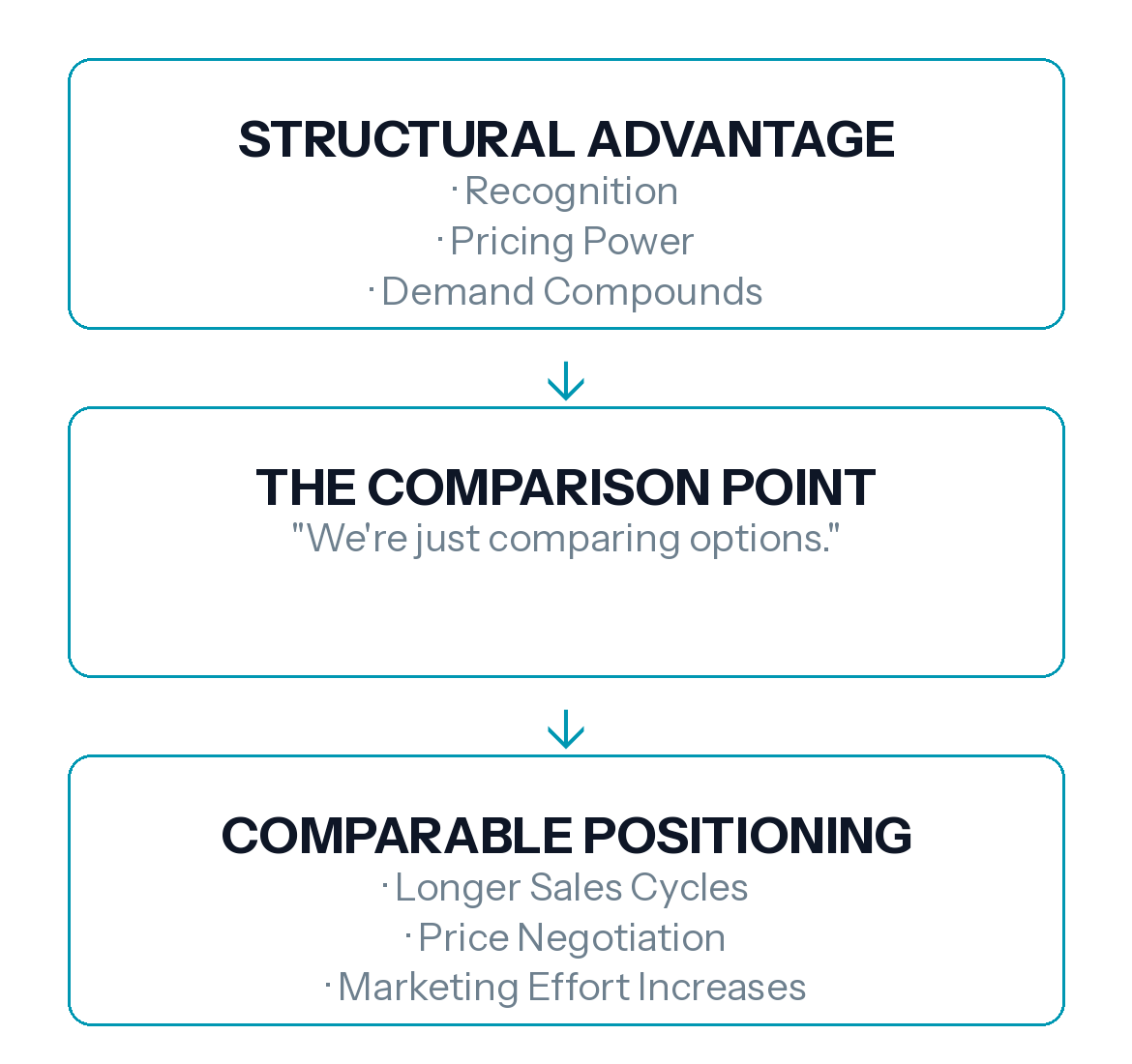
Optimisation improves performance. Reframing redistributes power. Those are different outcomes with different commercial consequences.
Why optimisation alone won’t create structural advantage is a question most scale-stage businesses never ask – because optimisation looks disciplined, rational and mature. They increase conversion, reduce churn, refine onboarding, tighten funnels and improve what already exists.
But optimisation rarely creates durable advantage.
It usually signals that leaders have already taken the easy structural moves and now polish what remains.
They change distribution, redefine infrastructure and they alter how value flows.
They don’t optimise the structure, they reshape it.
That reshaping creates asymmetric growth.
Then competitors arrive.
Playbooks form. Benchmarks solidify. Categories stabilise.
And optimisation takes over.
They reinforce the hierarchy.
They compete almost entirely on execution.
Execution improves performance.
It does not alter structure.
And when structure stays constant, advantage compresses.
+2% here. -4% there.
Useful.
Replaceable.
They see tighter competition and respond with more effort.
More product releases, experiments and more dashboards.
They optimise harder inside a structure they didn’t design.
But optimisation only strengthens equilibrium.
It rarely breaks it.
They don’t ask: “How do we improve this metric?”
They ask: “Does this structure still deserve to exist?”
That question feels dangerous.
It challenges assumptions, threatens comfort and disrupts consensus.
But structural leverage never comes from consensus.
It comes from reframing.
Markets reward businesses that alter hierarchy — not businesses that polish within it.
Optimisation improves performance.
Reframing redistributes power.
Those are different outcomes.
If your competitive advantage fits inside a percentage improvement, competitors can replicate it.
If you alter structure, competitors must adapt to you.
That is the difference between incremental growth and asymmetric growth.
Most businesses at scale are optimising inside a structure someone else designed.
The ones building durable advantage are asking whether that structure still deserves to exist.
If your business is working harder for the same results, if competitors are replicating your advantages faster than you can create them – the problem is rarely execution.
It’s structural positioning.
The Structural Advantage Score reveals whether your positioning is creating structural advantage or whether you’re optimising inside a frame that competitors can already match.
Take the Structural Advantage Score
The Forge Digital works with founders and leadership teams ready to reshape structure, not just optimise within it