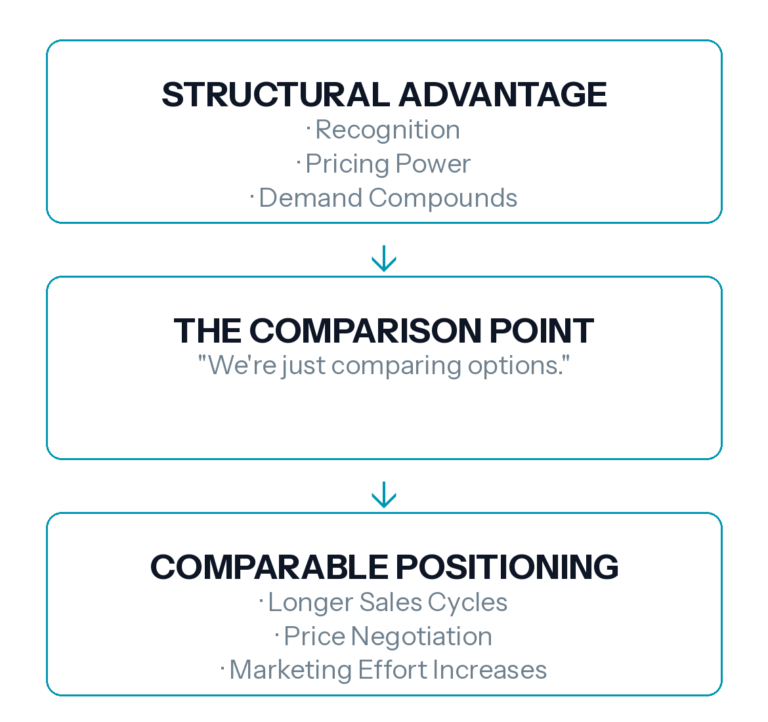
Most growth problems aren't marketing problems.
They're positioning problems.



Structural positioning determines your AI visibility. Brands that get cited aren’t the loudest, they’re the clearest.
Most founders and leadership teams assume that AI visibility is a marketing problem.
It feels like one. After all, visibility has historically been driven by channels, campaigns and publishing cadence, so it seems intuitive to assume that if your business is not appearing in ChatGPT, Gemini or Perplexity recommendations, the issue must sit somewhere inside the marketing function.
But in practice, what determines whether AI systems can confidently cite your company is not content volume, nor distribution strategy, nor even technical SEO execution. It is structural positioning.
And structural positioning is not a marketing decision. It is a leadership decision.
In theory, every organisation believes its visibility challenge is unique. Different industries, different maturity levels, different customer journeys. The tactical solutions vary accordingly: more thought leadership, more performance spend, better optimisation, more consistent publishing.
In practice, however, there is a repeating pattern.
The companies that consistently appear in generative AI responses are not necessarily the most active publishers, nor the largest advertisers, nor even the most polished brands.
They are the ones whose positioning is structurally clear enough to be recognisable.
And recognition is the variable that matters.
When executive teams notice declining visibility, the conversation typically gravitates toward execution.
The marketing team is asked to increase output, budgets are reallocated, agencies are brought in, keyword strategies are refined and new content pillars are developed.
All of these actions assume that visibility is created at the surface level and that the solution is simply to optimise more aggressively.
But generative AI does not reward effort in the way traditional search once did. It does not simply rank pages based on technical signals and backlinks. Instead, it synthesises patterns across articles, citations, reviews, commentary and discussion, and then attributes expertise to the companies most consistently associated with a clearly defined idea.
If your business sounds interchangeable with three competitors, AI has no strong signal to work with. It cannot confidently attribute ownership of a concept to you, so it defaults to whoever has established the clearest territory.
What appears to be a marketing underperformance is often a structural ambiguity.
Consider Notion.
Before Notion entered the market, productivity software sat in fairly well-defined categories. There were project management tools such as Asana and Trello, note-taking applications like Evernote, internal wiki systems, task managers and collaboration platforms. Each of these companies competed by incrementally improving user experience, adding integrations or expanding feature sets, while remaining firmly inside their respective categories.
Leadership debates in those organisations were likely centred on roadmap prioritisation, pricing tiers and user acquisition channels. The underlying category assumptions were rarely questioned.
Notion took a different approach.
Rather than positioning itself as a superior project management tool or a more elegant note-taking application, it reframed the problem entirely. It described itself as a workspace for thinking, implying that the core issue facing knowledge workers was not the absence of features, but the fragmentation of their cognitive environment.
This was not a marketing flourish. It was a structural repositioning of the company’s role within the ecosystem of knowledge work.
By redefining the frame, Notion was no longer competing within the traditional productivity buckets. It was constructing a modular, flexible system that could subsume notes, documents, databases and workflows under a broader conceptual umbrella.
As a result, when someone asks, ‘What tool can act as a second brain?’ or ‘What is a flexible workspace for knowledge management?’, Notion is relatively easy for both humans and AI systems to attribute as the answer.
Not because it publishes more content than its competitors, but because it has been consistently associated with a specific and recognisable territory.
The clarity was structural. And the structural clarity preceded the amplification.
Early-stage businesses are often sharper by necessity. With limited resources, they must focus narrowly, define their audience precisely and articulate a clear point of difference.
As companies scale, however, positioning often broadens. Additional services are introduced. New verticals are pursued. Messaging becomes more inclusive, more flexible and inevitably, more comparable.
The intention is rational: expand the addressable market, reduce perceived risk, appeal to a wider range of prospects.
The unintended consequence is erosion of structural clarity.
When positioning drifts into comparability, marketing efforts may continue to intensify, but the underlying signal weakens. AI systems scanning the landscape encounter multiple companies making similar claims, using similar language and occupying overlapping conceptual space.
In that environment, attribution becomes probabilistic rather than confident.
And generative AI systems are optimised for confidence.
When AI visibility begins to lag, the reflex is predictable: increase output. Publish more frequently. Experiment with new formats. Double down on distribution.
However, if the structural positioning underneath that content is indistinguishable from competitors, additional amplification merely increases the volume of overlap.
Noise rises. Signal does not.
The sequence matters more than most leadership teams realise.
Structural positioning must be defined first, at the level of category, territory and narrative ownership. Only then does content function as an amplifier of something distinct, rather than as an accelerant of sameness.
Reversing that sequence is one of the most common strategic errors currently being made.
There is also a structural constraint in generative AI that many executives underestimate.
Traditional search provided pages of results. Even a loosely differentiated company could secure a position somewhere in the rankings.
Generative AI does not operate that way. It typically cites two or three businesses per category when synthesising a response. This compression of recommendations means that visibility is no longer distributed across a wide spectrum of acceptable answers; it is concentrated among a small number of clearly attributable ones.
Patterns are forming now.
Once those attribution loops stabilise, displacement becomes significantly harder, because the system continues to reinforce the associations it has already learned.
This is not a short-term optimisation problem. It is a structural positioning window.
If you want a practical diagnostic, open ChatGPT and ask the question your ideal client would ask when searching for what you do.
Observe who gets cited.
If it is not your organisation, resist the instinct to commission more content.
Instead, ask whether your positioning is structurally distinct enough to be recognisable in the first place.
Because AI cannot confidently recommend what the market cannot clearly define.
Visibility in generative systems is not a publishing race. It is a structural clarity decision.
And structural clarity sits with founders and leadership teams, not with campaign calendars.
The companies that win in this era will not be the ones producing the most content. They will be the ones whose positioning is sufficiently clear, consistent and defensible that both humans and machines can immediately recognise what territory they occupyterritory, once clearly owned, is very difficult to displace.